What if trauma-informed practice included us, too?
It’s been 6 months since my book, Beyond Survival Mode: Thriving as a Trauma-Informed Professional, was published by Amba Press.
To mark the milestone, I’m sharing the first chapter free. It explores something I took a long time to understand: we cannot treat trauma-informed practice as something we offer young people while leaving ourselves outside it.
If you’re wondering what this work is all about, this is somewhere to begin.
——————
Every child deserves to have a safe and magical childhood, supported by adults who believe in their future. If you’re reading this book, you likely believe that quite deeply, too.
That belief is the reason I became a teacher. It’s the reason I took a graduate position in an alternative school. And it remained my reason each time I made a new career decision.
But for the longest time, I overlooked what it actually takes to make that belief a reality.
Well adults.
Adults equipped with trauma-informed knowledge. Adults supported with skills and resources to stay well while doing this important work.
According to the Substance Abuse and Mental Health Services Administration (SAMHSA, 2014), being trauma-informed invites us to:
realise how trauma shapes individuals, groups and communities
recognise the signs, symptoms and wide-reaching impacts
respond in ways that meet people’s needs and promote healing
prevent further harm or re-traumatisation.
And importantly, this work includes us, too.
This is why this book exists: to explore what it means to bring a trauma-informed lens to our own wellbeing, to our teams and to the communities we serve. When we understand these principles for ourselves, we are better placed to create environments where children and young people can genuinely thrive.
We will unpack trauma-informed practice more deeply in part II: Embed. For now, let’s notice what is happening within our trauma-impacted workplaces and within ourselves.
Becoming trauma-informed: it’s a journey, not a destination
The expectation that we can be immersed in suffering and loss daily and not be touched by it is as unrealistic as expecting to be able to walk through water without getting wet.
Rachel Remen (1996).
For too long, I think we liked to pretend we could support our trauma-impacted children and young people without feeling any of the impacts ourselves.
We thought we could stay dry while walking through water. Or at least, we chose to put up with the wet socks.
We have become skilled at applying trauma-informed practices to children and young people: helping them regulate, offering unconditional positive regard, supporting choice and voice.
But what we have not done well is incorporating trauma-informed wellbeing approaches with the adults doing the work: teachers, youth workers, social workers, residential carers, support workers, foster carers, allied health teams and sporting coaches.
What does it mean when we talk about trauma-informed wellbeing?
It’s not just a bunch of catchy words.
You’ve probably heard the term ‘trauma-informed’ being used in your sector, and you may even be a part of a trauma-informed school or organisation.
But how trauma-informed are we?
In recent years, trauma-informed practice has gained momentum across various sectors, including education, healthcare, social services, corporate environments, online spaces and even in design. It’s become a hallmark of progressive, compassionate practice, a term eagerly adopted by organisations and consultants alike.
But like many movements that gain popularity, its meaning risks becoming diluted, reduced to a buzzword stamped onto taglines and branding.
This movement, now almost a trend, aims to create safer, more supportive environments for everyone, acknowledging the pervasive impact of trauma on individuals and communities.
However, despite its widespread adoption, the depth and breadth of what it means to be truly trauma-informed is often misunderstood. It’s not as simple as having an ‘awareness’ of the presence of trauma, nor is it just about attending a one-day professional development course to obtain a certificate.
The allure of being labelled as trauma-informed is undeniable. It signifies a school or organisation’s commitment to understanding and mitigating the effects of trauma, promoting safety and wellbeing among staff and clients alike.
Yet the true essence of a trauma-informed approach goes beyond the surface level of catchy slogans and well-intentioned policies. It requires a profound shift in perspective, culture and practice. It’s an ongoing journey rather than a destination.

The early days: applying trauma-informed practice to my students
My first teaching experience was in an alternative high school that provided education to young people living in out-of-home care. The school was only a few years old when I started, and the understanding of trauma-informed practice in schools was just emerging.
Back then, there was a misconception that these young people didn’t want to attend school, so the school didn’t even have the word ‘school’ in its name. It had been opened in a building that couldn’t look less like a school: a converted warehouse with concrete floors and no natural light. Some of the staff members said we do ‘education by stealth’: get the young people in the door, treat them like they’re in a youth centre and trick them into learning a few things.
Luckily for me (and our students), new ideas in the field were emerging quickly, and an exceptional principal was guiding our campus towards being a place where our students felt safe and could engage in meaningful education, without the trickery.
In the first few weeks, I was provided with some trauma training. It was helpful; it gave me insight into what trauma can do to the brain, why my students might behave in certain ways (the ways that we often label as ‘challenging’), and strategies I could use to support these young people.
Trauma was presented to me as a big, dark cloud that loomed over my students. It was something rare, something that happened to them but not to many others. Something separate to me. They needed specialised practices to help them cope, and that’s what trauma-informed education was all about.
In those early years, I applied trauma-informed practice to these young people. I used co-regulation strategies, met them with unconditional positive regard, provided them with choice and shared decision-making, saw their behaviour as reactions to their trauma and worked to understand their triggers.
And each day, I went home and took off my trauma-informed hat, imagining my own life existed outside the realm of trauma.
I believed trauma-informed practice was something they needed, not me. And that was a common belief in the field.
But, during those early days and weeks, I was also trying to teach myself how to walk through the water without getting wet. I was told that I might find the work emotionally challenging or stressful, but that I would learn to manage it, and it would stop impacting me over time. I was led to believe that those who stay in the field long-term are the ones who stop feeling the impacts.
So, I never mentioned my wet socks.
Ignoring the collective experience
The application-only approach misses something vital. Trauma is not just an individual experience; it is relational, collective and systemic. It affects all of us.
Using trauma-informed practices can be great in supporting others to feel safe, to create moments of co-regulation and to minimise harm, but it’s not enough. We cannot use trauma-informed practice effectively if we see ourselves as separate from it.
Treating trauma as an individual issue disregards the systemic and relational aspects of trauma. We are all interconnected, and our experiences of trauma and healing influence one another.
We need to recognise:
we are part of the relational system
we shape and influence the environments around us
we heal together; we are participants in the healing of ourselves and others
we are impacted by the work.
Trauma is not just a clinical issue; it’s a human experience. And when we acknowledge that, we begin to see trauma-informed practice for what it really is: compassion in action.
It’s about understanding that we are all part of the same fabric, and healing is a journey we undertake together, shaping better environments, systems and policies along the way.
And, if we want to provide safe, supportive environments for the children and young people we are supporting, we must understand and invest in our own wellbeing, too.
Let’s get clear on wellbeing
Too often in the helping professions, we speak of wellbeing as something we hold for others. We focus on improving student or client wellbeing. We show up consistently for the children and young people in our care. We think of wellbeing as something to build around them.
But too rarely do we ask what that means for us. Rarely do we ask how we build safety, connection and nourishment around ourselves.
For years, I didn’t ask either. I assumed my wellbeing would take care of itself if I just worked hard enough. If I could stay calm, hold space and make it to the school holidays, I told myself I was doing fine.
The reality? I had no meaningful understanding of wellbeing beyond not burning out. And I wasn’t alone.
How psychology shaped our narrow view of wellbeing
The idea that wellbeing is simply the absence of distress is deeply woven into the history of psychology itself.
The field of modern psychology was born in a time of crisis. It gained momentum during the 20th century against the backdrop of world wars, displacement and collective trauma. Its focus was on understanding what had gone wrong and how to repair it.
So, we learned to speak fluently about pain. We created names for disorders and detailed plans to manage them. We learned how to move away from suffering.
But not how to move towards wellbeing.
For a long time, the working assumption was: if you’re not unwell, you must be well. Wellbeing became a linear line, zero on a scale, and all our systems were built to help people claw their way back to it.
Our understanding of psychology looked a little something like figure 1.
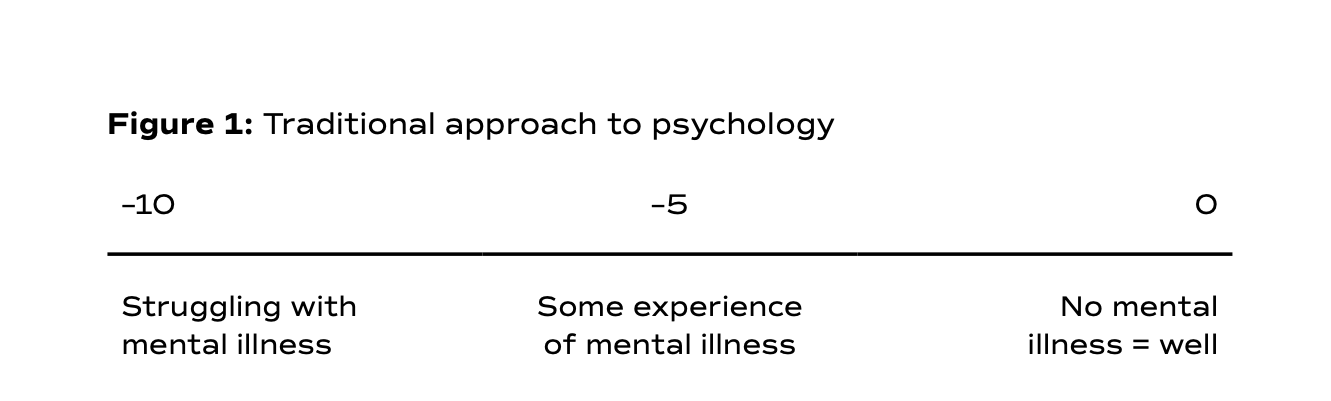
Zero was the goal.
Zero meant you were functioning.
Zero meant you were well.
But zero is not enough. Wellbeing is not just the absence of illness. It’s not just surviving, or getting through, or making it to the weekend. It’s something richer and more expansive.
Before you read on, I’d like you to pause and think about the word ‘wellbeing’:
How do you define it?
How do you talk about it with your students, clients or colleagues?
What does it mean in your daily life?
There is no single universal definition, but wellbeing science offers a widely accepted idea: ‘Wellbeing is feeling good and functioning well’ (Keyes & Annas, 2009).
Feeling good isn’t just about happiness; it’s about having a healthy emotional baseline and the capacity for positive experiences, relationships and connection.
Functioning well means showing up in our lives with competence, engagement, meaning and purpose.
And of course, these two feed each other. When we feel good, we function better. When we function well, we tend to feel better.
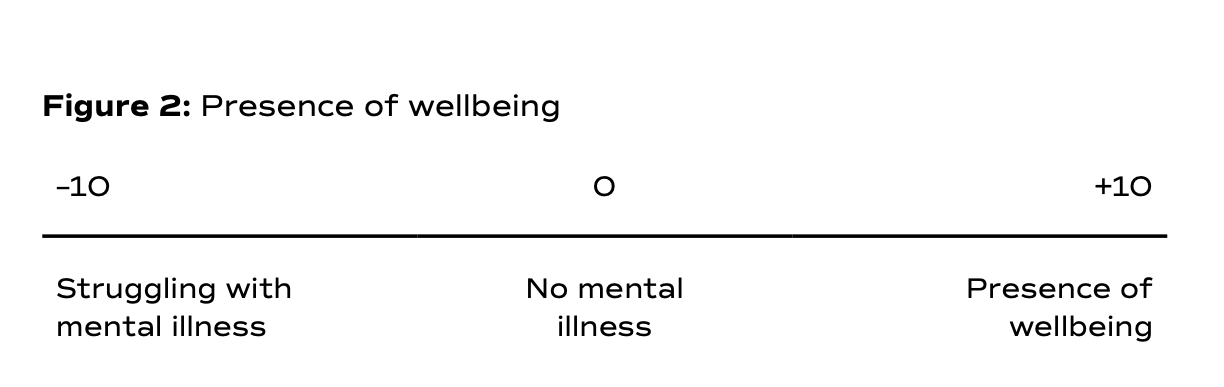
With the growing body of research in wellbeing science, we now get to look beyond that zero baseline (see figure 2).
The trauma-informed wellbeing journey
Trauma impacts our capacity to feel good and function well. It disrupts our connection to ourselves, to others and to the world, which we will explore further in chapter 2.
On our trauma-informed journey, it’s essential that we bring wellbeing science with us. If we set out with only the tools to prevent and respond to trauma, we’ll make it partway, but eventually the supplies run out. We become stretched, tired and pushed back by the weight of the work.
But when we carry the tools that also strengthen us, nourish us and help us thrive, the journey changes. We’re able to go further, with steadier steps and a fuller sense of who we are.
We must also understand that building safety, connection and supporting regulation in others is intimately tied to how we experience those things ourselves.
Wellbeing has to be something we practice, something we embody and something we invest in.
Completing the mental health picture
After a number of years working alongside my students, I began my Masters of Applied Positive Psychology (MAPP), exploring the science of wellbeing.
Wellbeing science felt like a revelation – a reminder that we aren’t here just to prevent harm, but to cultivate growth, hope and flourishing. I began applying some of the practices in my own life – gratitude journalling, learning about my character strengths and diving into self-compassion practices. Slowly, things shifted.
But a question kept following me through my studies:
Where were my students, who had been impacted by trauma, in the research and frameworks?
Where were the people like me who were exposed to stress and trauma in our workplaces?
If we look back at Figure 2, it presents a binary picture: either you have an experience of illness, or you have an experience of wellbeing.
The binary model, with illness on one end and wellbeing on the other, didn’t reflect what I saw in real life. It didn’t seem fair (or true) that wellbeing only begins once we’re free of trauma or mental illness. I wanted more for the young people I was supporting, and honestly, my own experiences didn’t fit on that singular line, either.
Amid my frustration in my studies, I did eventually experience a huge sigh of relief as I came across the work of Dr Corey Keyes and the Dual Continua Model of Mental Health.
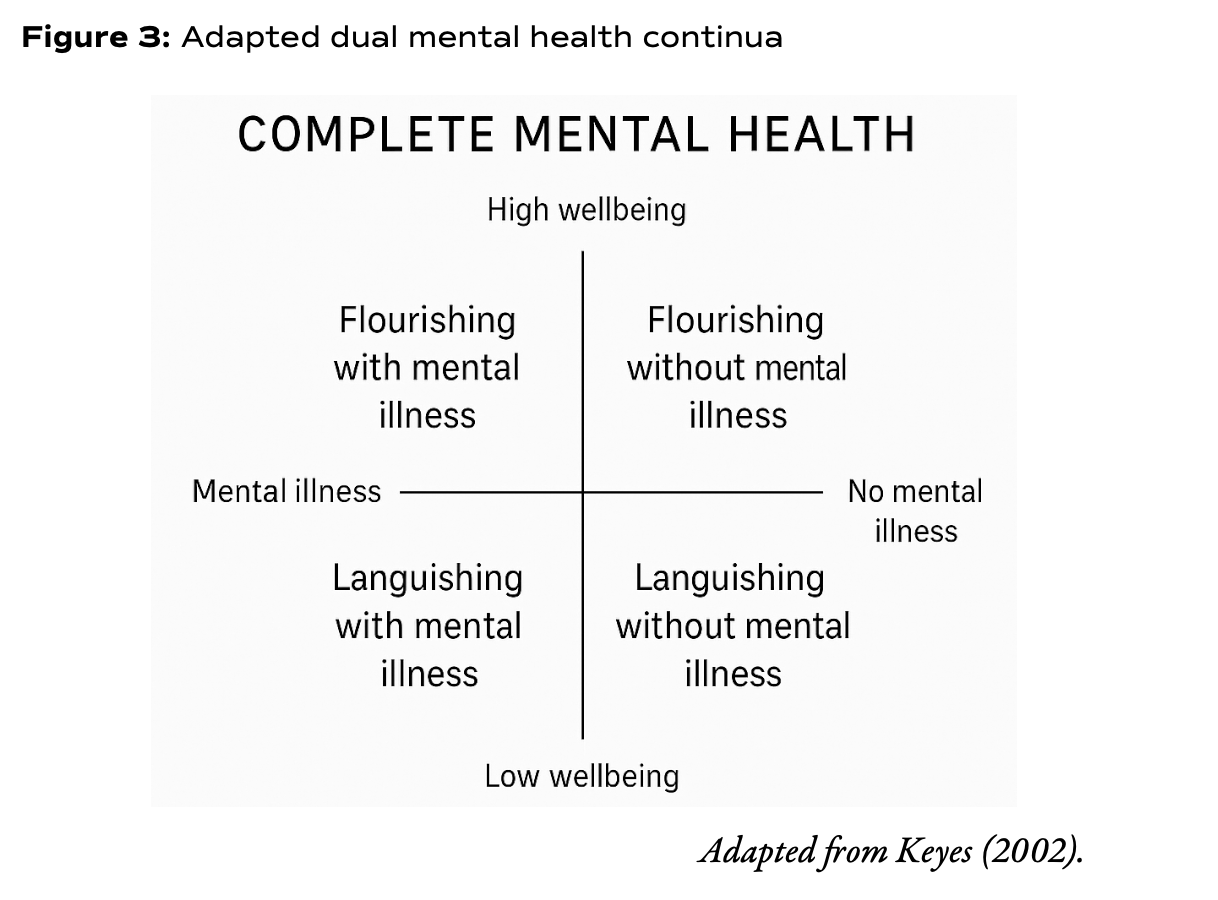
Keyes’ model illustrates that mental illness and mental health are related but distinct. The model uses the terms ‘flourishing’ and ‘languishing’.
Languishing is a feeling of aimlessness, emptiness and lack of vitality, characterised by the absence of mental wellbeing. This term gained a lot of traction during our lengthy COVID lockdowns, particularly here in Melbourne. At that time, I personally experienced languishing as I lost access to many of my usual wellbeing strategies, such as my boxing training and community, my regular dinner catch-ups with friends, and road trips out of the city.
In contrast, flourishing is a state of true wellbeing where individuals feel a sense of purpose, connection, personal growth and overall fulfilment.
For many, trauma sits on the illness axis. But trauma does not remove someone’s capacity to flourish on the wellbeing axis.
A person can:
experience mental illness and flourish
have no mental illness and languish
be healing and thriving at the same time.
A person can be thriving amid their healing, and healing amid their thriving – something many trauma-impacted people know intuitively.
I spoke with Corey Keyes in early 2025, and he shared something that has stayed with me. He explained that as he became more mentally healthy, his mental illness didn’t disappear; it simply moved into the background, into the closet. Flourishing stepped into the foreground. Life felt fuller, richer, more connected. The illness was still there, just quieter.
There are days when our mental illness comes back out of the closet – not as a sign that we’ve failed or that we’re back at the beginning, but simply because that’s how being human works. On those days, Corey says we have to welcome it in. We don’t slam the door on it. We don’t pretend we’re fine. We let it sit with us for awhile and, in doing so, we create room for something new.
He described this through the lens of recovery. Recovery isn’t the absence of symptoms; it’s the process of building the things that contribute to our mental health and wellbeing. It’s what we grow, not what we get rid of. And when our mental illness comes forward again, he says it’s there to ‘clean the house’, to help us notice what needs attention, what needs clearing and what needs care.
The dual continua model serves as a powerful reminder: we can all learn the skills of wellbeing. We all deserve the resources and support to sustain it. And we all benefit from trauma-informed understanding and approaches to our wellbeing.

What’s getting in the way of practitioner wellbeing?
Over the past few years, I’ve had the privilege of working with schools, youth centres, councils, mental health services and universities across Australia and the UK. At the time of writing, I’ve supported thousands of professionals and carers, and I have learned from every one of these interactions.
While every setting is unique, I’ve noticed consistent themes that compromise staff wellbeing, regardless of the sector. These themes include:
trauma exposure without evidence-informed support
behaviour of students or clients
unsafe team culture
unmanageable workload.
If you take a moment to consider what is compromising your wellbeing, it is likely the challenges can be mapped to one of these categories.
Furthermore, none of these challenges can be solved by individual wellbeing practices.
As practitioners, we often hold complex trauma, emotional labour and systems under strain. We are doing our best within environments that unintentionally reinforce burnout.
I’ve seen staff pushed to breaking point while being told to practise self-care as though meditation apps or gratitude journals can undo the damage of chronic stress, unsafe team dynamics or role ambiguity.
Wellbeing, like trauma, is not just personal – it’s relational and systemic. When we are unsupported in the face of trauma exposure, when behaviour is managed rather than understood, when boundaries are blurred and team culture is unsafe, we can’t expect people to just ‘look after themselves’.
The work of trauma-informed wellbeing begins by recognising these deeper patterns and asking better questions. Instead of asking why staff aren’t coping, we need to ask: What are we doing, or not doing, that makes it so hard to thrive here?
In the chapters ahead, we’ll explore the root causes of practitioner distress and offer evidence-informed, relational, and practical ways we can do better, together.
Wagtail Wellbeing – building our NEST
Working in complex settings asks a lot of the humans who show up each day. It asks us to hold space for others while also navigating our own stories. It asks us to support healing while often working inside systems that can cause harm. And it asks us to care deeply, sometimes without having the structures in place that care for us.
This is where the Wagtail Wellbeing NEST framework comes in. It’s a model developed through years of walking alongside educators, youth workers, mental health professionals and lived-experience teams. It’s not a checklist or a program; it’s a way of seeing and doing that helps us hold complexity with compassion. It’s a roadmap I wish I had when I began supporting children and young people.
The framework weaves together trauma theory, wellbeing science and real-world practice. It recognises that for us to support healing in others, we need environments that are safe, connected and sustainable for ourselves. It invites us to move beyond surface-level wellbeing strategies and embed trauma-informed principles in meaningful, systemic ways.
Notice
We begin by noticing the impact of trauma and adversity in the lives of the people we support, and in our own lives. We pay attention to how trauma shows up in behaviours, relationships, team dynamics, and systems. We also learn to notice what is already present and working: the skills, values and capacities that often go unseen in environments shaped by stress. This stage is about naming what’s real, reducing shame and creating a shared understanding that becomes the foundation for change.
Embed
We embed trauma-informed practice at every level of our work. This includes staff culture, leadership practices, workplace structures and the ways we respond to one another. We intentionally build safety, trust and empowerment, not only for the people accessing our services, but for those delivering them as well.
Strengthen
We strengthen our practices, relationships and systems so that they can hold steady under pressure. This stage is about building capacity, resilience and alignment, ensuring that the principles of trauma-informed practice are lived out consistently, even when challenges arise. It’s where leaders reinforce the conditions that allow their teams and communities to flourish.
Thrive
Trauma-informed practice is not only about reducing harm, it’s about creating the conditions for growth, purpose and joy. In this final stage, we move beyond survival, drawing from the science of wellbeing and positive psychology. We focus on strengths, belonging, connection and meaning. We imagine what it looks like when individuals, teams and systems don’t just cope, but truly thrive.
Throughout the book, we’ll return to this roadmap. Each chapter will explore one part of the model in more depth, offering stories, strategies and reflections to help you bring trauma-informed wellbeing to life in your setting.
Chapter summary
Trauma-informed practice is not about applying to others, but about being with others and being with ourselves.
Wellbeing is not the absence of illness, but rather the presence of feeling good and functioning well.
A person can flourish even while healing from trauma. Flourishing and illness can co-exist.
Instead of asking why staff aren’t coping, we need to ask: what are we doing, or not doing, that makes it so hard to thrive here?
Individual wellbeing strategies cannot fix systemic issues. Wellbeing is relational and collective.
For us to support healing in others, we need environments that are safe, connected, and sustainable.
The Wagtail Wellbeing NEST acronym stands for: Notice, Embed, Strengthen and Thrive.
From insight to impact
Reflect on your current context. What factors are shaping your wellbeing, both positively and negatively? Consider your team culture, leadership, workload and how supported you feel in your role. What’s helping? What’s hindering?
Reframe self-care. Shift the focus from individual responsibility to shared accountability. Ask: What would it look like if our team or organisation genuinely supported practitioner wellbeing? What needs to be in place for that to happen?
Start conversations. Use this chapter as a conversation-starter with colleagues or leaders. What parts resonate most with your experience? What feels realistic to shift? Where can you begin?
—————————
Continue Reading
This is the first chapter of my book, Beyond Survival Mode: Thriving as a Trauma-Informed Professional, published by Amba Press. If you’d like to keep reading, you can purchase a copy here.
To celebrate 50 clients and partners, we’re offering a second copy free when you buy the book, so you can share it with a friend or colleague.
Simply add two copies to your cart and enter SALE50 at checkout. The offer is available until 21 December 2026.
References
Keyes, C. L. M. (2002). The mental health continuum: From languishing to flourishing in life. Journal of Health and Social Behavior, 43(2), 207–222.
Keyes, C. L. M., & Annas, J. (2009). Feeling good and functioning well: Distinctive concepts in ancient philosophy and contemporary science. The Journal of Positive Psychology, 4(3), 197–201.
Remen, R. N. (1996). Kitchen table wisdom: Stories that heal. Riverhead Books.
Substance Abuse and Mental Health Services Administration. (2014). SAMHSA’s concept of trauma and guidance for a trauma-informed approach (HHS Publication No. SMA 14-4884). U.S. Department of Health and Human Services.